A smart system for indoor and outdoor navigation on university campuses that explores the potential of 5G technology
Keyword
5G Technology, Co-creation, Digital Fabrication, IoT, Prototipazione, Research
Period
2020 - 2023
Financed by
Coordinator
Partner
Contribution by
BASE 5G is a research and innovation project funded by the Lombardy Region and coordinated by the Politecnico di Milano with the involvement of the Departments of Electronics, Information and Bioengineering, Design, Mechanics, Architecture and Urban Studies and the collaboration of a pool of Lombardy-based companies: Vodafone, LIFE, AnotherReality, Yape and AKKA.
The BASE 5G project has developed a process of research, design, prototyping and testing of a series of use cases aimed at experimenting with 5G technology in areas such as Smart Mobility and Smart Logistics and within urban areas (Smart City) and large public buildings (Smart Campus).
The objectives of the BASE 5G project operate on two levels. The first level explored, identified and defined the various elements of the design processes necessary to ensure vertical integration of 5G technology with IoT platforms, in order to support the development of product-service systems in sectors such as mobility, logistics and the management of people flows in urban environments. The second level is linked to the specificities of each individual use case, their design and experimentation activities in relation to the use of 5G technology.
Within BASE 5G, Polifactory coordinated the co-creation and co-design phases of concepts related to Smart Direction, Smart Parking and Smart use cases, as well as participating in the prototyping and testing phase of these solutions together with the ANTLab, IoTLab laboratories and the DASTU Department of the Politecnico.
In particular, Polifactory oversaw the design and prototyping of the Polaris project relating to the Smart Direction use case. This is a smart system for indoor and outdoor navigation within spaces such as university campuses. The campus is a complex environment with different types of spaces, activities and user categories that constitute a navigation grid very similar to that of a city. The idea behind Polaris is that the design and testing of a smart navigation system developed for a campus can subsequently be scaled up to an urban context.

Photo credits: Polifactory
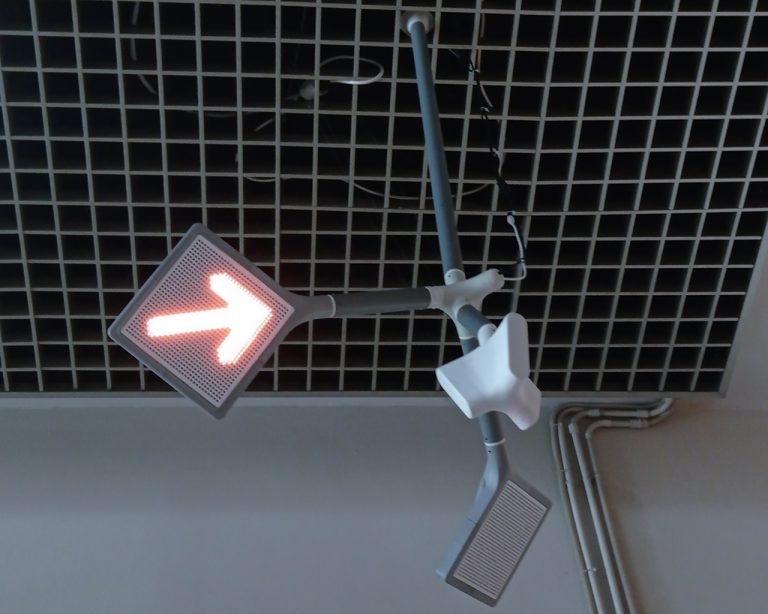
Photo credits: Polifactory
Polaris is an intelligent navigation system that seamlessly guides the user to their desired destination using 5G technology. Starting from an analysis of the benefits and disadvantages of existing navigation services, the project provides the user with simple guidance information and very precise directions to guide a user on foot across the campus in a 2D and 3D plan. This feature helps to fill the gap in 3D guidance (vertical and horizontal navigation, for example, when looking for a classroom located on the third floor) that is usually present in other systems.
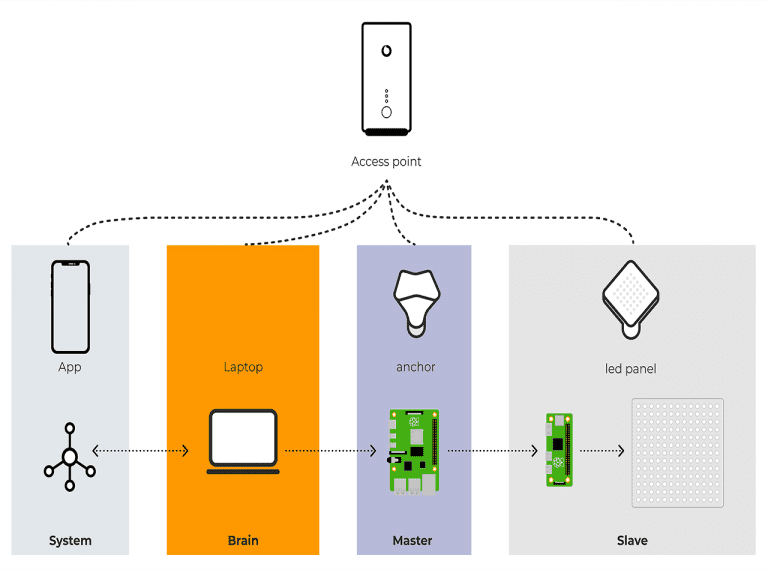
Image credits: Polifactory
The Polaris system consists of four elements: an app installed on the user’s smartphone, a “brain” element, one or more “master” elements (which act as “anchor” communication nodes), and one or more “slave” elements (which act as effector nodes) to be installed in a distributed manner in the environments to be navigated.
These intangible and tangible elements communicate constantly with each other during the user’s journey and choices. Using the new features and advantages of 5G, the Polaris system performs constant and rapid communication triangulation between the app and other hardware and software elements located throughout the campus, allowing the user to move around without having to look at their smartphone screen and providing constant visual references on the next steps of their route.