
An international research and education network exploring how design can contribute to the construction of peace ecosystems in urban contexts
Keyword
Design for Peace, Urban Conflict Mapping, Participatory Design, Food Justice, Design for Social Innovation
Period
2024 – 2027
Financed by
European Commission, Erasmus+ KA171 Program (Mobility Project for Higher Education Students and Staff)
Coordinator
Polifactory (Department of Design - Politecnico di Milano)
Partner
Design Factory (Pontificia Universidad Javeriana) and LGD/NEXT Labs (Pontifícia Universidade Católica do Rio de Janeiro)
Design for Peace Ecosystems (D4PE) is an international research and education network exploring how design can contribute to the construction of peace ecosystems, making structural conflicts in urban contexts visible and enabling spaces for dialogue and collective transformation. The project connects three partner universities — Politecnico di Milano, Pontificia Universidad Javeriana (Bogotá) and PUC-Rio (Rio de Janeiro) — in a distributed research and teaching programme across three academic years within the Erasmus+ KA171 framework.

Conflict mapping workshop, Milano Aprile 2025, Credits Design for Peace Ecosystem Network
The project is grounded in the conviction that design can operate as an infrastructure for participation and social innovation: collecting and synthesising data, developing operational tools, and co-producing knowledge with the communities and institutions involved. Urban food systems serve as the common terrain of inquiry, as it is here that structural inequalities — in access, recognition, and decision-making power — are most visible and politically contestable.
Year 1 – 2024: Designing for Peace in Cities In the first year, the three partner universities developed parallel, situated initiatives in their respective cities, exploring how design education can contribute to the construction of peace ecosystems. In Bogotá, the Viendo-T programme supported the social and labour inclusion of Venezuelan migrants. In Rio de Janeiro, the SYNAPSES project engaged children and local residents in the participatory re-imagination of public spaces as environments of peace and belonging. In Milan, a first conflict map was developed as a participatory methodology for visualising urban tensions and fostering civic empowerment.
Year 2 – 2025: Participatory Urban Conflict Mapping
The second year focused on the development and testing of a participatory urban conflict mapping protocol (Participatory Urban Conflict Mapping), through a series of workshops held in the three network cities, with urban food systems as a common entry point.
Milan workshop (Politecnico di Milano, 16–17 April 2025): 20 Design master’s students worked over two full days mapping food-related urban conflicts in Milan, identifying 25 conflicts on themes including foodification and migrant labour conditions, animal welfare, food markets, and school canteens.
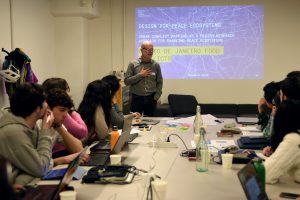
Conflict mapping workshop, Milano Aprile 2025, Credits Design for Peace Ecosystem Network
Rio de Janeiro workshop (PUC-Rio, 1–3 July 2025): 21 multidisciplinary participants (design, architecture, geography, environmental engineering) mapped conflicts related to the right to the city and food access, with particular attention to indigenous, quilombola, and favela communities, artisanal fishing, and the expansion of dark kitchens linked to delivery platforms.
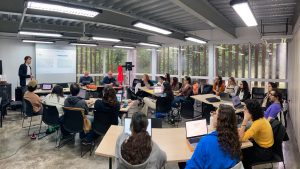
Conflict mapping workshop, Rio de Janeiro Luglio 2025, Credits Design for Peace Ecosystem Network
Bogotá workshop (Pontificia Universidad Javeriana, 7–11 July 2025): 20 participants explored conflicts related to informal street vending and public transport regulation, informal labour precarity, urban gardens, and the symbolic overvaluation of meat as a social status marker.
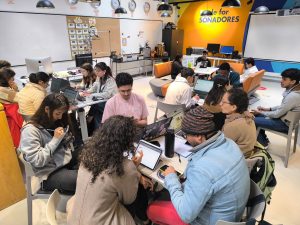
Conflict mapping workshop, Bogotá, Luglio 2025, Credits Design for Peace Ecosystem Network
All three workshops followed a four-phase mapping protocol, data collection, analysis and categorisation, georeferenced visualisation with QGIS, and collective restitution, treating participants as co-researchers.
Following the workshops, the course Design for Peace Ecosystem: Urban Conflict and Food Justice was conducted at PUC-Rio (August–December 2025), developed within Laura Cipriani’s Doctoral Research. The course engaged students of design, engineering, architecture, and social sciences in a four-phase experiential learning programme: participatory conflict mapping, desk research on food care practices, rapid ethnographic fieldwork, and the development of design interventions for food justice.
Year 3 – 2026: During 2026, the research team will propose three further urban conflict mapping workshops to refine the protocol and release the platform as a civic infrastructure, one that draws on participatory design tools to move beyond conflict mapping alone, and opens arenas for debate and co-design of more equitable and inclusive urban futures.
For more information, visit: designforpeace.net
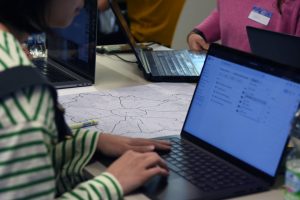
Conflict Mapping Workshop, Milano Maggio 2026, Credits Design for Peace Ecosystem Network